Commitment to Sustainability
The University of Western Australia (UWA) is deeply committed to embedding sustainability into all aspects of campus operations, guided by its Sustainable Development Goals (SDG) Program and alignment with the UN’s 2030 Agenda for Sustainable Development.
UWA’s Sustainability Strategy prioritizes:
- Reducing environmental impact through sustainable operations and responsible resource use.
- Educating and empowering students to become sustainability advocates.
- Leveraging digital technologies to enhance both ecological and academic outcomes.
This commitment is visible across university life from campus energy initiatives to transport planning and education models and aligns strongly with the Student Engagement team’s aim to promote resource-efficient student services and experiences.
Challenge
UWA had been actively seeking more sustainable approaches to campus communication, including reducing reliance on printed materials.
- An environmental footprint inconsistent with UWA’s sustainability goals.
- Increased reliance on physical handouts and staff intervention for wayfinding support.
Solution
In alignment with UWA’s vision to enhance the student experience and sustainability initiatives, the Student Engagement team, led by Chloe Leopold, transitioned to a digitally-focused wayfinding model using MazeMap.
Key steps taken:
- Minimize paper consumption: Reduced printed map production from 10,000 to 1,000 copies per year.
- Installed QR code signage at: Student lounges, reception areas, study corners and admin office doors.
- Front-line staff practices: Instead of distributing printed maps, staff empower students to access MazeMap for help navigating the campus.
Impact: Measurable Results in Sustainability, Student Experience & Operational Efficiency
Operational Efficiency
- Significant reduction in student inquiries related to being lost or needing directions.
- Front-desk staff spend less time explaining directions and more time on high-value student support.
- Unlike printed maps, MazeMap has functionality to incorporate toilet locations, bike racks, steps on how to find exact buildings and internal rooms.
Student Empowerment and Digital Fluency
- Students now engage proactively with MazeMap as a first point of contact.
- Feedback highlights that students feel more confident and independent: “I wish I had known about MazeMap earlier.” “Now I can find anything on campus by myself.”
- Contributes to a stronger sense of belonging and orientation, especially during Open Day, Orientation Week and beginning of semester.
Sustainability Outcomes
- 90% reduction in printed materials for campus maps.
- Thousands of pages of paper saved annually, contributing to waste and emissions reduction.
- A scalable model that can be replicated for other print-heavy student services.

“By embedding MazeMap into our daily operations, we’re not only reducing our environmental footprint but also giving students a tool that empowers them to take charge of their own campus experience. It’s a small shift with a big ripple effect.”
- Chloe Leopold, Team Lead, Student Engagement, UWA
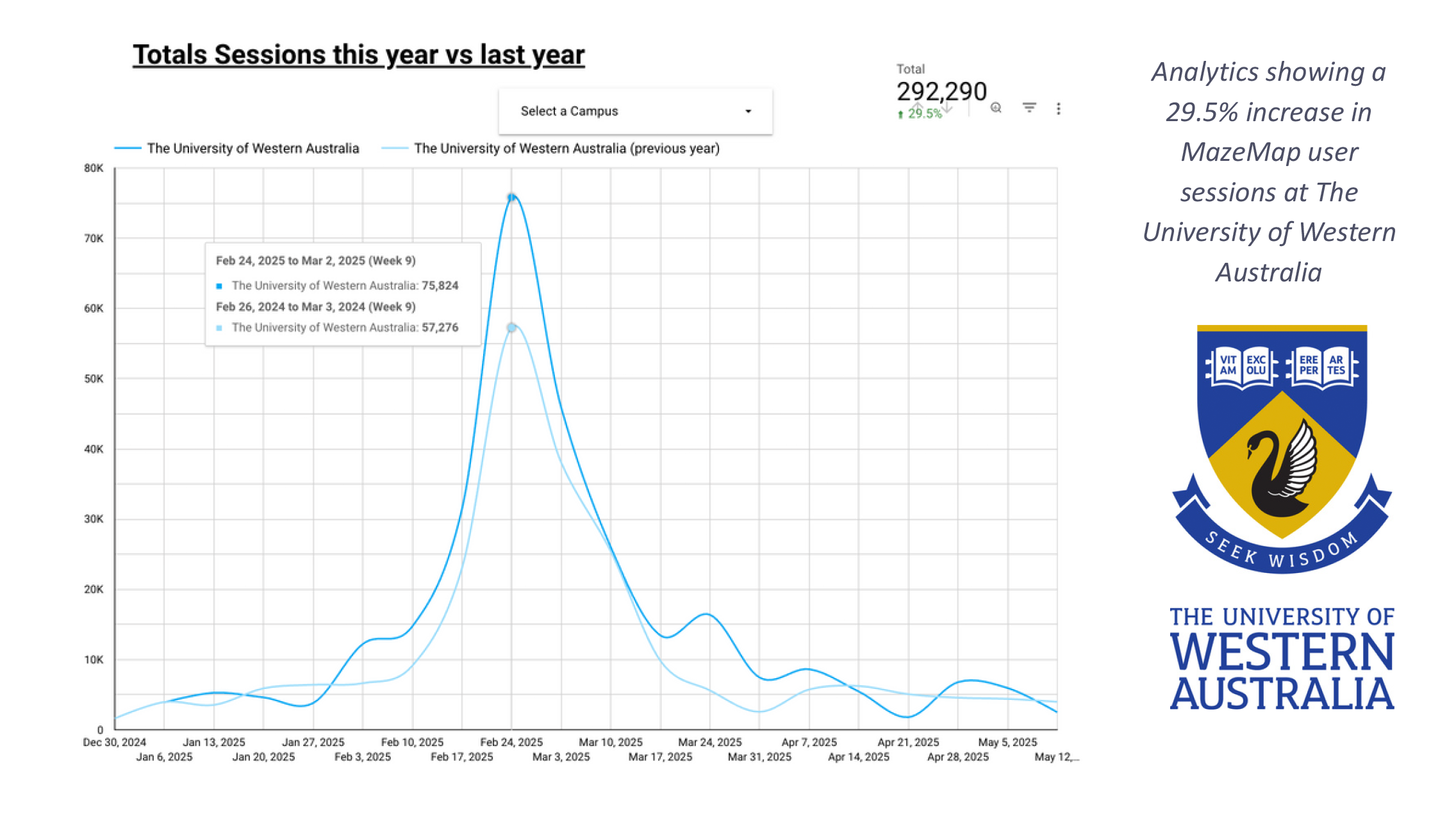
Analytics show a 29.5% increase in MazeMap user sessions at The University of Western Australia.